 |
Launch of the spacecraft.
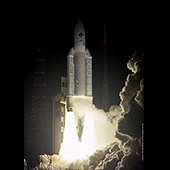
On 2 March 2004 Rosetta (and its lander Philae) launches at 8:17 a.m UTC in French Guiana (Kourou) by an Ariane 5 rocket. The spacecraft was initially supposed to be launched for January 2003 but because of a failure of a rocket in December 2002; it was postponed to March.
Thus, the 10-year journey is marked, Rosetta is led to its target: the comet Churyumov-Gerasimenko. |
 |
1st Earth gravity assist
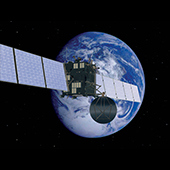
On 4 March 2005 Rosetta uses the Earth gravity to boost speed. Rosetta was about 2,000 kilometers above the Pacific ocean. This flyby is the first of a serie that Rosetta will live during its journey. Indeed, the boost is needed to boost speed and therefore, get the spacecraft the correct trajectory to meet up the comet. |
 |
Mars gravity assist
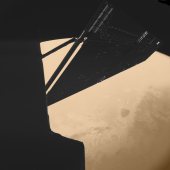
On 25 February 2007 the spacecraft was at a distance of over 200 kilometers of Mars. By the way, Rosetta takes an unforgettable self-portrait with the Red Planet by its camera OSIRIS (the opposite photo).
At Mars, Rosetta gets its second gravitational boost to change the spacecraft's direction.
|
 |
2nd Earth gravity assist
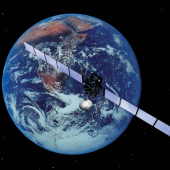
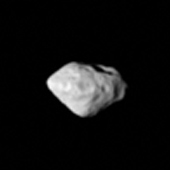
On 13 November 2007 Rosetta swings by the Earth once more and whizzes about 5,300 km from the surface. It took beautiful pictures of our planet and the Moon by its camera OSIRIS. Therefore the spacecraft is sent towards the outer Solar System with newly-gained energy. |
 |
Flyby of the little Asteroid 2867 Steins
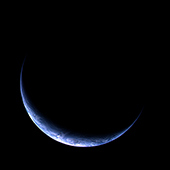
On 5 September 2008, the spacecraft was at a distance of around 800 kilometers of the asteroid Steins during its trip through the asteroid belt (between the orbit of Mars and Jupiter).
Steins is an diamond-shaped asteroid measuring 5 km long. Rosetta revealed its shape for the first time; it was the first target of the spacecraft. |
 |
3rd Earth gravity assist
On 13 November 2009 Rosetta crossed the Blue Planet at a distance of less than 2,500 km to pick up its last gravitational boost. At this point, after having travelled around 4,500 million km (more than 63% of its whole journey), Rosetta has now gained enough energy to achieve its encounter with comet 67P/Churyumov-Gerasimenko. |
 |
Rendezvous with asteroid Lutetia
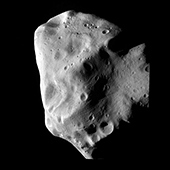
On 10 July 2010 Rosetta cruises near the asteroid Lutetia, its second target, at a distance of 3,162 km. Rosetta reveals a battered world of many craters, it is most probably a primitive survivor from the violent birth of our Solar System. Lutetia’s longest side is around 130 km. |
 |
Rosetta enters hibernation
On 8 June 2011 Rosetta enters a long energy-saving state of hibernation during which virtually all systems on the spacecraft except the onboard computer and the hibernation heaters are shut down. In this way, Rosetta has gone past the orbit of Jupiter and can survive its enormous distance from the Sun and the weakness of the sunlight falling on its solar panels, which cannot produce enough electricity to power the probe fully. |
 |
Rosetta wakes up
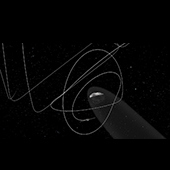
On 19 January 2014 Rosetta’s internal alarm clock wakes up the spacecraft from its two-and-half-year slumber. Rosetta restaured the communication with ESA's Operation Center. On one of the most exciting moments for Rosetta scientists and mission operators on Earth, the spacecraft calls back home confirming everything is working fine and that it has survived the most distant part of its journey. By the way, the spacecraft's Twitter account sends a brief message : "Hello, world!" |
 |
Approaching the comet
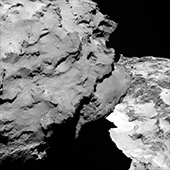
Between May and August 2014 Rosetta performs a series of ten complexes manoeuvres to reduce the separation between the spacecraft and comet from around 20 million km to 100 km. From this close distance, scientists can determine the best landing spot for the Philae lander. Rosetta becomes the first mission to orbit the nucleus of a comet. |
 |
Rendevous with the comet
On 6 August 2014 Rosetta arrives at the comet and takes a series of impressive images. 67P/Churyumov-Gerasimenko is a small comet just 4 km in its longest dimension. It looks incredibly like a duck and a diverse surface: a priceless treasure trove for Rosetta scientists, ready to start their exploration adventure. |
 |
Philae landing site is selected
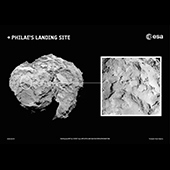
On 15 September 2014 ESA announces the best spot for Philae to land, called ‘J’. |
 |
Philae lands on the comet!
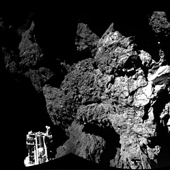
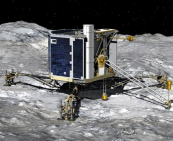
After that ESA announces on 15 September 2014 the best spot for Philae's landing (nicknamed 'J'), the Philae lander was released by the Rosetta spacecraft and touched down three times on the comet on 12 November 2014 at 16h03 UTC. Nevertheless there were some problems such as :
- the curve of energy which was variable whereas it should have been perfectly consistent.
- the period when Philae was lost.
- the battery which was four time inferiors to what was predicted. Thus we needed fastly to bore before the battery drains.
- The drilling failed unfortunately...
- Another drilling took place by good luck. However the lander bored in an empty space.
These problems happened in two days after the landing but we don't have to forget that it was a first in the history of space exploration. Landing on a comet, a tiny low-gravity celestial body moving at a speed of several tens of thousand km/h, was never achieved before.
|
 |
Publication of the results!
On 22 January 2015 whereas before the scientific data were hidden to the public, the magazine Science published it. Click here to read it. |
 |
Nearest approach to Sun
The next perihelion passage for comet 67P/Churyumov-Gerasimenko falls on 13 August 2015. The comet will be at a distance of about 186 million kilometers (i.e. 1.24 AU) from the Sun. During this time, the comet will heat up and thus be more active, so give out more gas and dust.
Rosetta will continue to escort the comet, checking how its activity decreases and providing unique insight into both daily and long-term changes taking place on and around the comet. In parallel the operation is an extreme challenge. Not only the team tries to keep the spacecraft close to the comet to do good science, but they have to make sure that it remains safe.
|
 |
End of the mission
Rosetta's nominal mission will end on 31 December 2015 after a lifetime of almost 12 years. Nonetheless there may be a six-month extension proposed. |