LEXICON
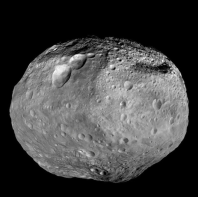
Asteroid:
An asteroid is a small (the diameter is roughly between one and several hundred kilometers) and irregularly shaped object in space that orbits our Sun. There are around a million asteroids located between Mars and Jupiter in the area known as the “asteroid belt”.
The asteroid is mostly made up of rock and metal. Therefore these celestial objects become dangerous because they can cause lots of damage if they collide with a planet.
By the way, the craters on the Moon were formed by asteroids.
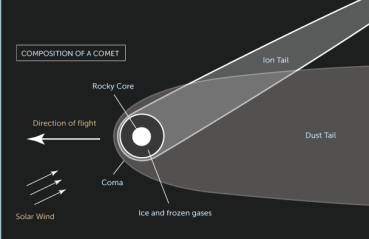
Comet:
A comet is an icy and dusty body which orbits the Sun. It is made of dust mixed with ices, such as:
- Water (H20)
- Carbon dioxide (CO2)
- Ammonia (NH3)
- Methane (CH4)
These dust and ices come from the time when the Solar System was formed. A comet gets an icy center (called the nucleus) surrounded by a large cloud of gas and dust (called the coma). When the ice in the nucleus is warmed by the Sun, then it vaporizes to create the coma.
When a comet travels closer to the Sun, two tails can be developed by the comet:
- A gas tail (too called ion tail) which is created by the solar wind, when the gas is pushed away from the comet’s coma and sent to the Sun.
- A dust tail which is vaporized by the Sun’s heat and form a curved tail which follows the comet’s orbit.

Horizon 2000:
The Horizon 2000 is a scientific program of the ESA from 1984 to 2000. This program started in order that the agency get a long-term plan. It originally contains four missions called “cornerstones”:
- The spacecraft SOHO & the satellite Cluster
- The orbit XMM-Newton
- The spacecraft Rosetta
- The space observatory FIRST (renamed Herschel)
They aim to considerably make progress the scientific knowledge.
However, there are others missions less costly such as the satellite Hipparcos, the spacecraft Ulysses or the lander Huygens.
This scientific program is extended by the program Horizon 2000+ which begins in 2006 and ends in 2015. It included three main missions:
- An exploration mission BepiColombo.
- The satellite Gaia which extend the mission of the satellite Hipparcos.
- Lisa: a space mission concept designed to detect measure gravitational waves.

Henceforth, the program is Cosmic Vision (2015-2025). There are three large missions (called the L-class projects), their budget is €900,000,000:
- The spacecraft JUICE
- The telescope ATHENA
- Another large mission which is still to be announced (it might be Lisa).
There are four medium-size missions (called M-class and with a budget of €500,000,000) whose one is already not chosen and one small mission (called S-class and with a budget of €50,000,000): CHEOPS.
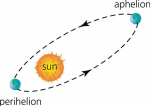
Perihelion:
The term perihelion come from the Latinizations of Ancient Greek peri (which means near) and helios (which was the Greek god of Sun). Therefore the perihelion indicates the point in the orbit of a celestial object where it is closest to the Sun.
At the same time the term aphelion is the point where it is farthest to the Sun.
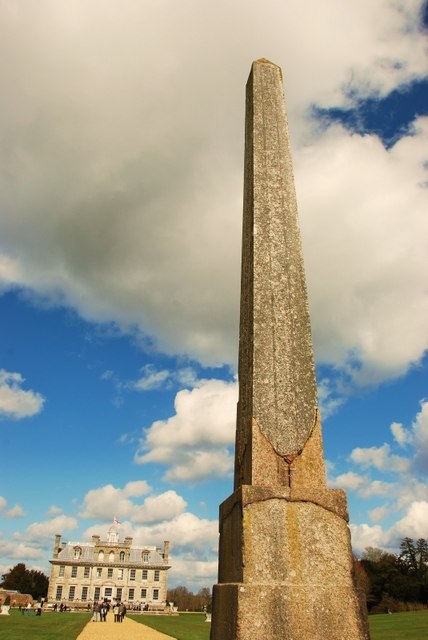
Philae obelisk:
Philae is a 7-meter-tall granite obelisk which is written both ancient Greek and Egyptian hieroglyph. It is dated about 118 or 117 BC and found at Philae (a submerged island in the Upper Egypt) in 1815.
This obelisk was originally used as a request of a tax cut from a group of priests in Egypt to their king Ptolemy VIII. It was then used by the Egyptologist Jean-François Champollion to decode hieroglyphs in the same ways as the Rosetta stone.
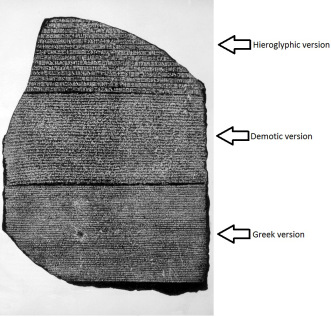
Rosetta Stone:
The Rosetta Stone is a stone with writing on it in two languages: the Egyptian and the Greek. It uses three scripts, that is the hieroglyphic, demotic and Greek. It was carved in 196 B.C. and found in 1799 by French soldiers who were rebuilding a fort in Egypt in a small village called Rosetta (Rashid).
It holds the key to understand the Egyptian hieroglyphs; we have never lost the understanding of ancient Greek, therefore Greek inscriptions provided a key to decoding their Egyptian equivalents. After lots of years of studying the stone and other ancient Egyptian writings, Jean-François Champollion (who could read both Greek and coptic) was able to deciphere hieroglyphs in 1822 and thus, we could understand the three thousand years of ancient Egyptian history.
The text was simply a decree listing benefits assigned to Egypt by King Ptolemy V.