ROSETTA
Rosetta is a space probe which was launched in March 2004 by the European Space Agency (ESA) on the Cornerstone Mission. There are two big solar panels on each side; that is to say 64m². That's why the spacecraft measures 32m. It weighs 3,000 kg (or 3 tonnes). Since its launch, Rosetta travels about 6.5 billion kilometers.
Rosetta is composed of twelve parts:
- ALICE is an Ultraviolet Imaging Spectrometer which aims to characterise the composition of the nucleus and the coma of comet 67P. This instrument is looking at the ultra-violet range from 70 to 205 nm.
ALICE measures the abundances of noble gases in the coma to determine the temperature history of the comet. Besides ALICE measures the abundance of hydrogen, carbon, nitrogen, oxygen and sulphur atoms in the coma. On 25 February 2007, ALICE studied Mars during its flyby and on 10 July 2010 asteroid Lutetia.
- CONSERT (Comet Nucleus Sounding Experiment by Radio wave Transmission) is a scientific experiment on board. It provides information about the deep interior of comet 67P by studying radio waves that are reflected and scattered by the nucleus.
It operates between one module on the Rosetta orbiter and another on the Philae lander.
A radio signal is transmitted from Rosetta orbiter and received on Philae lander, where some data are extracted and immediately re-transmitted back to the Rosetta orbiter, where the main experiment data collection occurs.
- COSIMA (Cometary Secondary Ion Mass Analyser) is used to analyse the characteristics of dust grains emitted by the comet, it includes their composition and whether they are organic or inorganic. It is equipped with a dust collector, a primary ion gun and an optical microscope for target characterization.
- GIADA (Grain Impact Analyser and Dust Accumulator) analyses the dust environment of the comet coma measuring the number, mass, momentum and velocity distribution. The grains that travel directly from the nucleus to the spacecraft and those that arrives from other directions having had their ejection momentum changed by solar radiation pressure.
- MIDAS (Micro-Imaging Dust Analysis System) is a high-resolution atomic force microscope, whose the goal is to investigate several physical aspects of the dust particles around the comet (and the asteroids that were visited during the jourey).
It provides information on particle population, size, volume and shape.
- MIRO (Microwave Instrument for the Rosetta Orbiter) can detects the abundance and temperature of volatile substance (primarily methanol, ammonia, water and carbon dioxide) by way of their microwave emissions. It aims to investigate the nature of cometary nucleus, outgassing from the nucleus and development in the coma.
- OSIRIS (Optical, Spectroscopic, and Infrared Remote Imaging System) consists of two independent cameras; a wide-angle and a narrow-angle camera, both sharing an electronic system. They can obtain high-resolution images of the comet's nucleus.
The narrow-angle camera is made to operate at distances of between 500,000 km and 1 km from the comet and thus image the surface to a resolution of up to 2 cm per pixel.
- ROSINA (Rosetta Orbiter Spectrometer for Ion and Neutral Analysis) is composed of two sensors which determine the composition of the comet's atmosphere and ionosphere, the speeds of electrified gas particles and reactions in which they take part. ROSINA can also investigate possible asteroid outgassing.
- RPC's (Rosetta Plasma Consortium) goal is to measure the phyical the physical properties of the nucleus, examine the structure of the inner coma and the monitor cometary activity and study the comet's interaction with the solar wind. It is a combined group of five instruments :
- ICA (Ion Composition Analyser) to measure the velocity and mass distribution of ions and study the the plasma environment of the comet and its interactions with dust and gas.
- IES (Ion and Electron Sensor) to characterise the forces that drive the development of the comet's coma.
- LAP (Langmuir Probe) to measure the cometary plasma.
- MAG (Fluxgate Magnetometer) to measure magnetic fields produced where the solar wind interacts with the coma.
- MIP (Mutual Impedance Probe) gots two functions. The first is to measure the gas density of electrons, the temperature and the velocity of particles within the inner coma. The second is to monitor dust and gas activity in the nucleus and gas activity in the nucleus and to make spectral measurements between 7 and 3,500 KHz.
- RSI (Radio Science Investigation) uses the frequency shifts in the spacecraft's radio signals to measure the mass and gravity of the comet nucleus so as to deduce its density and internal structure to define the comet's orbit and to study its inner coma.
By the way during the flyby in 2010, RSI has determined the mass and density of asteroid Lutetia and the solar corona, during the periods when the spacecraft was passing behind the Sun in 2006 and 2010.
- VIRTIS (Visible and Infrared Thermal Imaging Spectrometer) is an instrument used to map and study the nature of the solids and the temperature of the nucleus. It studies the composition of the comet nucleus and coma through the use of spectroscopy using visible and infrared wavelengths. It identifies too comet gases and characterises the physical conditions of the coma and helps to identify the best landing sites.
- Philae
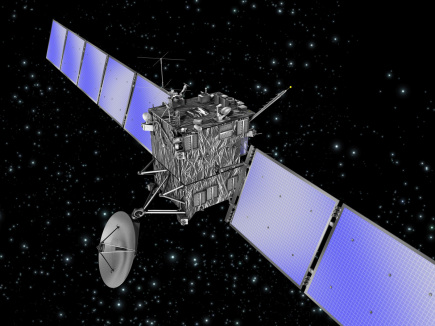
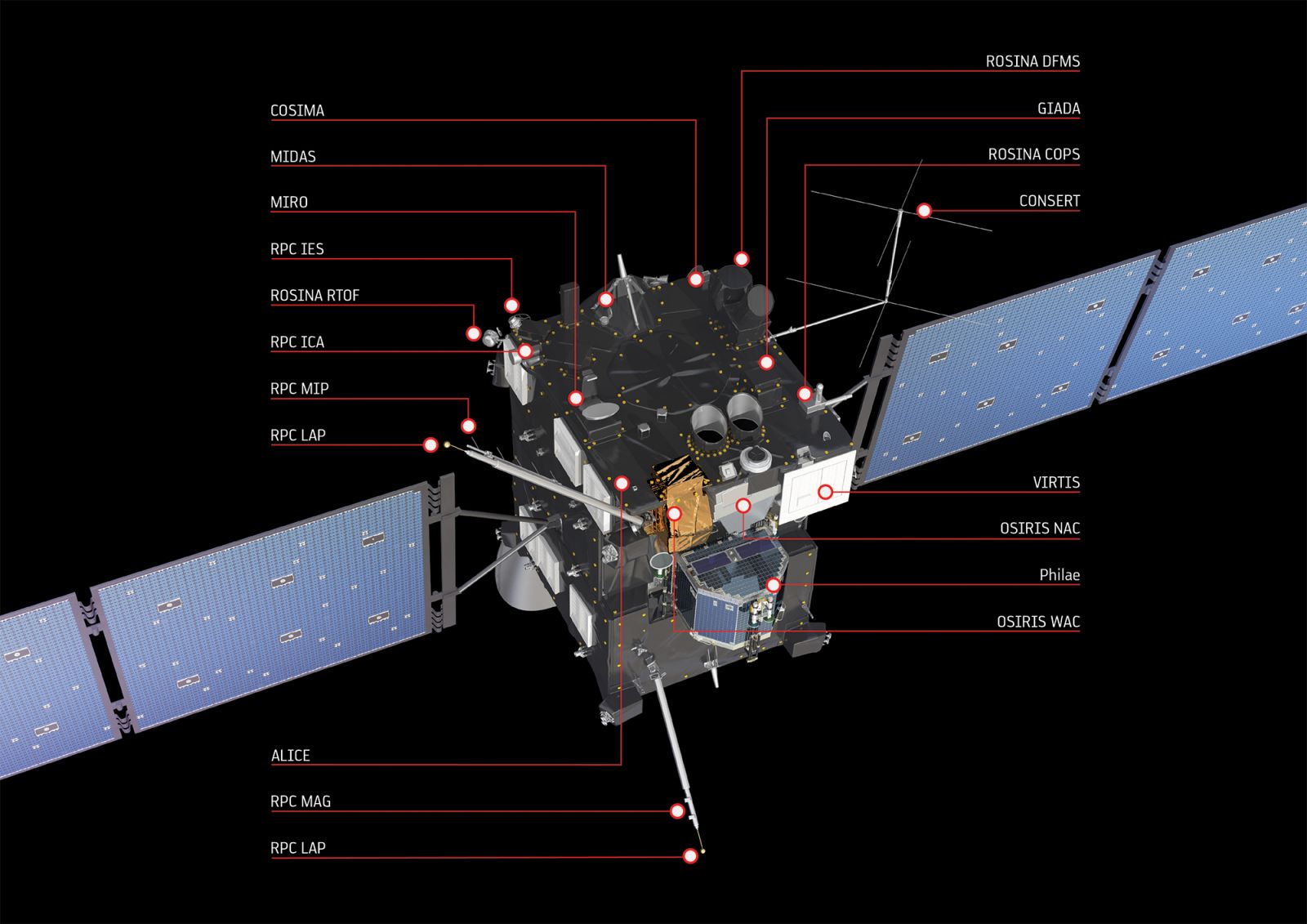
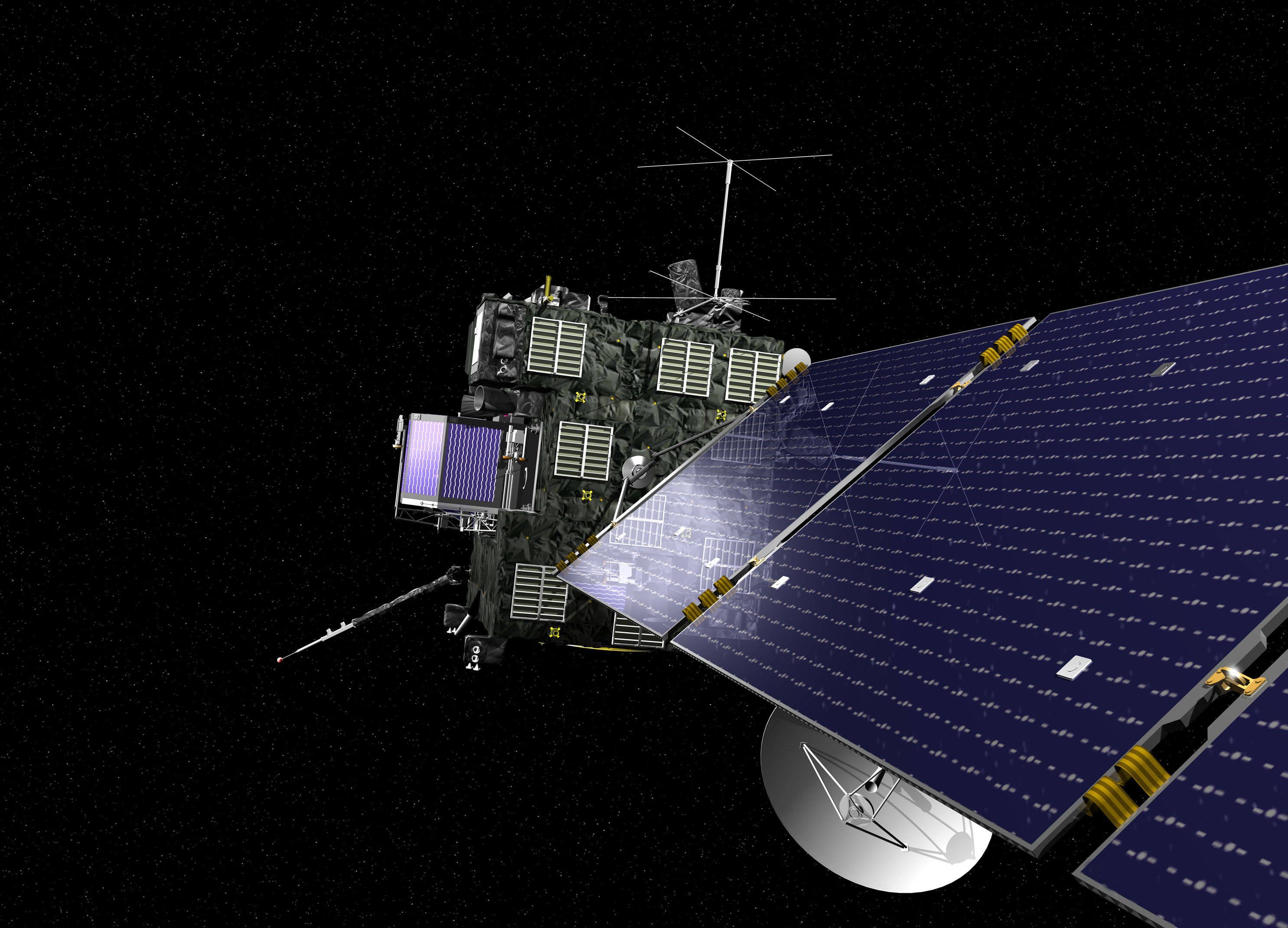
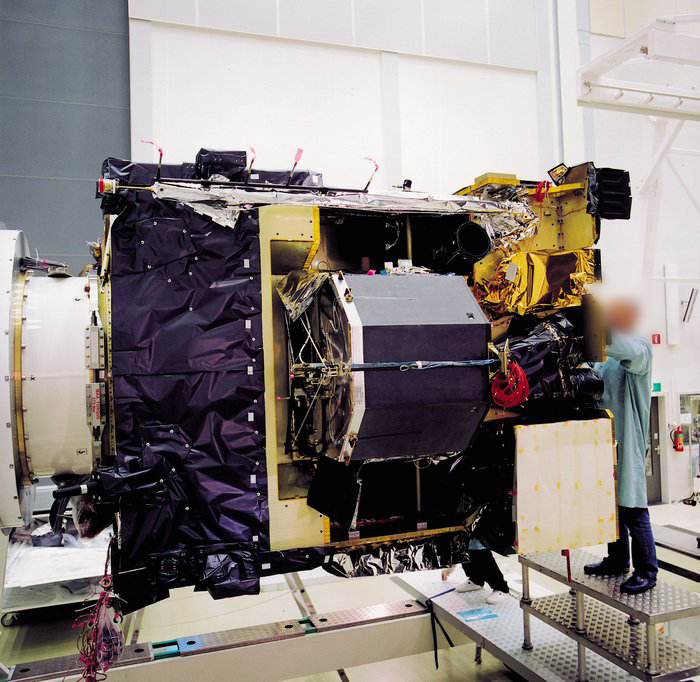
Some of them are antennas, databases, fuel tanks, cameras (particularly Osiris) and processor. They are rouglhy used in the investigation of the nucleus, solar wind interaction, gas and particles. There are also many instruments on Philae used to detect gases, dust, solar wind, plasma or differents waves' types.